


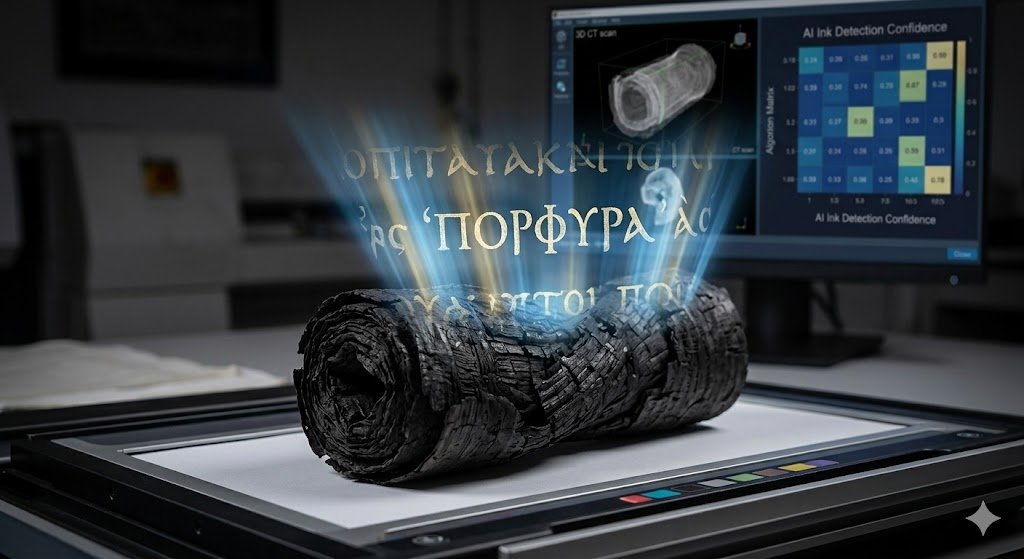
Herculaneum Scrolls AI technology is an incredible success story that is currently revolutionizing the field of ancient archaeology. For over two millennia, the secrets locked inside a carbonized library from the Roman Empire were considered lost forever. When Mount Vesuvius famously erupted in 79 AD, it did not just destroy the city of Pompeii; it also buried the neighboring town of Herculaneum under meters of superheated volcanic ash. Today, thanks to a massive leap in modern computing and machine learning, we are finally reading the unreadable.
The Carbonized Library of the Ancient World
Discovered deep underground in the 18th century, the Villa of the Papyri in Herculaneum contained an astonishing collection of over 800 rolled-up papyrus documents. Historians believe this luxurious villa may have belonged to the father-in-law of Julius Caesar. However, the extreme heat from the volcanic eruption had flash-fried the entire library, turning the fragile scrolls into blackened, charcoal-like logs.
For centuries, researchers faced a heartbreaking dilemma. Any physical attempt to unroll these brittle scrolls resulted in absolute disaster. The carbonized papyrus would instantly crumble into dust, completely destroying the invaluable historical text hidden inside. Because of this extreme fragility, the vast majority of the collection remained securely locked away, holding onto the deep secrets of Roman and Greek philosophy, science, and literature.
The Vesuvius Challenge and Herculaneum Scrolls AI Breakthrough
The massive turning point arrived with the official launch of the Vesuvius Challenge in 2023. Spearheaded by Dr. Brent Seales, a dedicated computer scientist at the University of Kentucky, this global machine-learning competition aimed to solve the ultimate ancient puzzle using twenty-first-century innovation.
Dr. Seales and his dedicated team had already utilized high-resolution X-ray CT scans to map the complex internal structures of the rolled scrolls. However, translating those scans into readable text was another massive hurdle entirely. To accelerate the process, researchers turned to advanced artificial intelligence. The primary goal was to develop a specialized Herculaneum Scrolls AI model capable of accurately detecting invisible ink buried deep within the 3D scans.
How Machine Learning Revealed the Invisible Ink
The primary technical challenge was that ancient Romans and Greeks utilized carbon-based ink for their writing. Because both the papyrus material and the ink had completely turned into carbon during the volcanic eruption, standard X-ray machines could not tell the difference between the two materials.
To brilliantly overcome this obstacle, brilliant software developers trained specialized Machine Learning (ML) models. The Herculaneum Scrolls AI software was meticulously trained to look for microscopic, 3D texture differences and structural patterns on the papyrus surface caused by the dried ink. Through a highly technical process called “Virtual Unwrapping,” the software digitally flattened the complex layers of the scroll and highlighted exactly where the ink was located, allowing the ancient letters to finally pop out.
The First Words Emerging from the Ashes
In late 2023, the artificial intelligence model successfully achieved a historical milestone by detecting the very first whole word inside an unopened scroll: “πορφύρα” (porphyras), which is the ancient Greek word for the color “purple.”
By early 2024, a dedicated team of brilliant tech specialists won the $850,000 Grand Prize by successfully reading over 2,000 ancient Greek characters from a single scroll without ever touching it. The beautifully decoded text was originally written by the ancient Greek philosopher Philodemus. In the text, he deeply discusses how music, visual beauty, and delicious food directly influence our human enjoyment of life.
Why This Amazing Discovery Matters for Our History
Most of the classical historical texts we study today are merely copies of copies, manually transcribed by dedicated monks during the Middle Ages. Natural human error and deliberate political alterations have inevitably occurred over the centuries.
The documents uncovered by the Herculaneum Scrolls AI technology, however, are completely original manuscripts. They serve as unfiltered, pure voices speaking directly from the ancient Roman Empire. As artificial intelligence models become significantly faster and more accurate, passionate archaeologists hope to eventually decipher the remaining hundreds of scrolls.
This incredible technology possesses the power to potentially uncover lost Greek plays, unknown Roman histories, and groundbreaking philosophical works that could completely rewrite our modern understanding of human civilization.
Learn More About Ancient History
If you are fascinated by ancient mysteries and newly uncovered civilizations, be sure to check out our other detailed article on the remarkable Lost Amazonian Cities right here on Histivo.
To follow the ongoing progress of this remarkable technological journey and read the official reports, you can visit the official Vesuvius Challenge Website.