



For centuries, the Great Pyramid of Giza (the Pyramid of Khufu) has fueled countless myths, legends, and wild conspiracy theories. However, in recent years, modern science has achieved what traditional archaeology could not. Through advanced particle physics, scientists have confirmed the existence of a massive, hidden structure inside the ancient wonder: the Great Pyramid secret chamber, professionally known as the “Big Void.”
Unlike sensationalized clickbait on social media, this discovery is grounded entirely in rigorous, non-destructive physics. Here is the true story, the data, and the groundbreaking technology behind the hidden voids of Giza.
What is the “Big Void”? The Discovery That Shocked the World
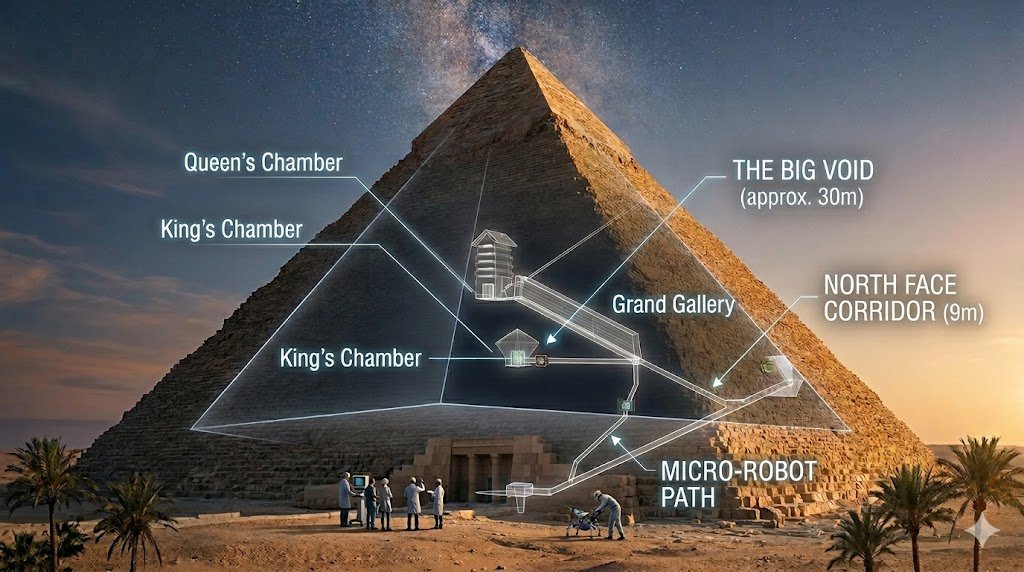
In November 2017, an international team of scientists working under the ScanPyramids Project published a groundbreaking paper in the prestigious scientific journal Nature. They announced the discovery of a massive, internal hidden space located directly above the Grand Gallery.
Here are the verified dimensions of this hidden anomaly:
- Length: At least 30 meters (approximately 98 feet) long.
- Cross-section: Visually similar to the Grand Gallery below it.
- Access: Completely sealed with no known connecting corridors or entrances.
In March 2023, the team struck gold again. They successfully mapped and photographed a second, smaller corridor near the original entrance on the north face, known as the North Face Corridor. As documented in detailed engineering reviews on ResearchGate’s ScanPyramids North Face Corridor Report, scientists fed a tiny, 5mm-wide endoscopic camera through a microscopic gap between the stones. This allowed them to capture the first actual images of this smaller chamber, proving that these voids are deliberate architectural structures, not random gaps.
The Science Behind It: How Cosmic Rays See Through Stone
How do you look inside a 4,500-year-old stone monument without knocking it down? The answer lies in outer space. The ScanPyramids project—jointly coordinated by Cairo University and international tech partners—utilized a cutting-edge technique called Muon Tomography.
- What are Muons? Muons are subatomic particles created when cosmic rays from deep space collide with Earth’s upper atmosphere.
- How it works: These particles shower down on Earth constantly. They can easily pass through empty air, but they are absorbed or deflected when they hit dense matter, like the massive limestone and granite blocks of the pyramid.
- The Detectors: Scientists placed highly sensitive chemical emulsion plates and electronic detectors inside known areas of the pyramid (like the Queen’s Chamber).
According to an official archaeological briefing by the DAAD Regional Office Cairo, measuring the number of muons passing through the monument from different angles allowed detectors to create a “3D X-ray” of the interior. An unexpectedly high concentration of muons in a specific zone meant the particles encountered less resistance—revealing a massive, air-filled hidden void.
Separating Fact from Fiction: What is Inside the Chamber?
Because this space has been completely sealed for over four millennia, rumors on the internet frequently claim it contains alien technology, ancient curses, or lost libraries.
However, leading archaeologists urge caution. According to scientific consensus, there are two realistic theories:
- An Internal Relieving Structure: The architects of the Great Pyramid may have deliberately built these voids to reduce the immense weight of the stones pressing down on the Grand Gallery and the King’s Chamber, preventing a catastrophic structural collapse.
- A Hidden Burial Corridor: It could be a separate, intentionally hidden passage leading to an undiscovered chamber belonging to Pharaoh Khufu.
The Next Steps: What Happens Next?
The research continues to expand beyond Khufu’s monument. Teams at the Technical University of Munich (TUM) are already testing similar non-destructive radar and ultrasound technologies on neighboring structures like the Menkaure Pyramid to look for air-filled anomalies.
Because the main 30-meter void inside the Great Pyramid remains inaccessible, scientists are currently designing advanced, ultra-miniaturized robotic scouts. The goal is to drill a microscopic hole (less than a centimeter wide) through the blocking stones to deploy a tethered flying or crawling robotic camera. Until that happens, the true contents of the Great Pyramid secret chamber remain one of history’s most fascinating, yet securely guarded, scientific mysteries.